Product:
OrgPublisher
Applicable Release:
All
Problem:
If your charts are not refreshing with the latest data, it is likely that the scheduled publishing was not successful.
Solution:
OrgPub32.exe process(es) hanging
The first thing to do is to log onto the server and bring up Task Manager. Then click on the “Processes” tab and make sure you have the “Show processes from all users” checked:
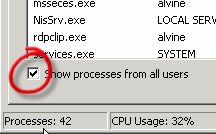
Look down the list to see if there are any errant OrgPub32.exe and/or opfontconversion.exe (if you’re publishing Silverlight charts) processes still running. If so, kill them and then try running the scheduled task again and see if that fixes the issue.
Email notification is enabled
Another situation that can cause OrgPublisher to not publish a chart via a scheduled task is when you have email notification turned on. This will happen if:
- You have email notification turned on AND
- Your data contains errors
This is because when you enable email notification, the default assumption is that you would not want to publish a chart with errors. This is especially true if you are publishing a secured EChart because the integrity of the security is dependent on the hierarchy. If the hierarchy’s integrity is compromised by data errors such as recursive records and/or orphaned records, then it follows that the integrity of the security rules can be compromised.
To address this issue, you can manually publish the chart by opening the source chart file in OrgPublisher and then publishing your chart that way. Alternately, you can create a registry entry that will override the default behavior and will force a scheduled publish to complete in spite of data errors. Here is the registry entry you will need to create:
| 32-bit Server | HKEY_LOCAL_MACHINE\SOFTWARE\Aquire\OrgPublisherX\Publish |
| 64-bit server | HKEY_LOCAL_MACHINE\SOFTWARE\Wow6432Node\Aquire\OrgPublisherX |
X is the version number of OrgPublisher you are using.
Ø Create a DWORD called StopOnDataError and set the value to 0.